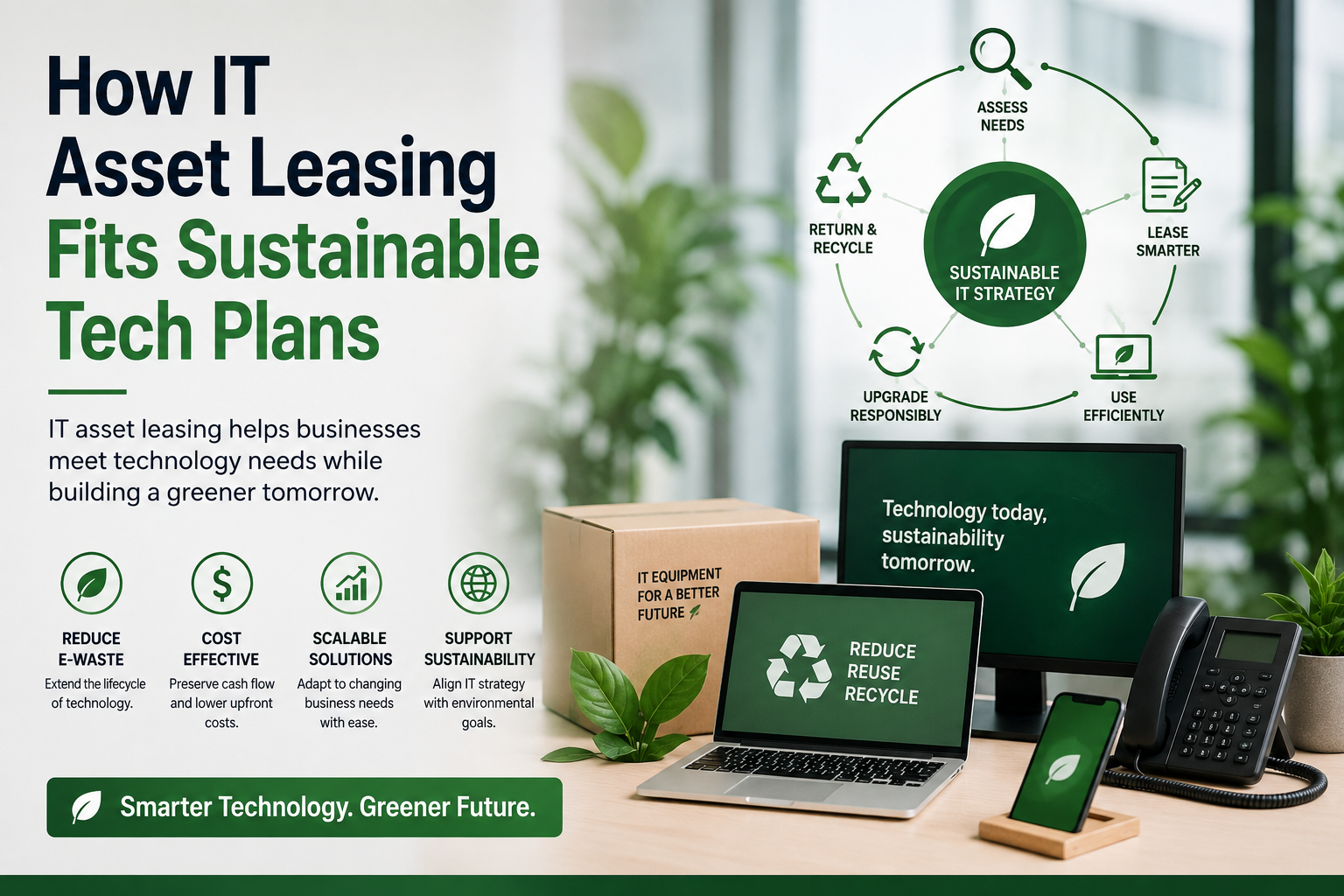
Sustainable IT planning is not only about buying energy-efficient devices or recycling outdated hardware. It also requires businesses to manage how technology is acquired, used, refreshed, recovered, and retired across its complete lifecycle.
IT asset leasing can support that model when contracts, accounting, asset tracking, and end-of-life processes are properly coordinated. For finance and IT leaders, the objective is to align technology refresh cycles with financial commitments while preventing usable equipment from becoming unmanaged electronic waste.
Match Lease Terms to the Useful Life of Technology
Leasing works best when the contractual period reflects how long the organization realistically expects to use the equipment.
Employee laptops may have shorter operational cycles than networking hardware or servers. If a five-year lease is signed for equipment the business normally replaces after three years, the company can end up paying for outdated devices that have already left active service.
Finance and IT teams should establish expected lifecycle periods by asset category before negotiating lease terms.
Consider warranty coverage, software requirements, security support, hardware performance, repair rates, and expected business growth when setting refresh cycles.
Connect Sustainability Planning With Lease Accounting
Sustainability decisions still need to fit the organization’s financial reporting requirements.
For UK businesses applying FRS 102, the revised Section 20 applies for accounting periods beginning on or after January 1, 2026. It generally introduces a balance-sheet model for qualifying lessee arrangements, subject to available exemptions.
Finance teams managing leased technology should understand the differences between FRS 102 vs IFRS 16. The standards share important principles, including recognition of right-of-use assets and lease liabilities for most leases, but differences remain in areas such as discount-rate application and some exemption and transition requirements.
Accounting should be incorporated into the procurement process rather than addressed after hardware has already been deployed.
Create One IT Asset Lifecycle Register
A sustainable leasing program requires visibility into physical equipment.
Maintain a register connecting each device or equipment pool with the relevant lease agreement, user, location, and expected return date.
Track the Full Asset Record
Useful data fields include:
Asset category and manufacturer
Serial number
Assigned employee or location
Lease commencement and expiration dates
Warranty expiration
Current condition
Repair history
Return requirements
Data-erasure status
Final disposition
This information allows finance, IT, procurement, and sustainability teams to work from the same asset population.
Use Leasing to Create Predictable Refresh Cycles
Unstructured technology replacement often produces two problems. Some equipment is replaced before necessary, while other equipment stays in service after performance or security support has deteriorated.
A controlled lease program can establish defined review points.
Instead of replacing every device automatically at lease expiration, evaluate condition and operational requirements several months beforehand. Some equipment may need replacement, while other assets may remain suitable if the contract permits an economical extension or purchase.
The goal is not maximum replacement frequency. It is avoiding both premature disposal and inefficient retention.
Build Circularity Into End-of-Lease Decisions
A sustainable IT plan should define what happens after your organization stops using an asset.
Equipment may be returned to the lessor, purchased, refurbished, redeployed, resold, harvested for parts, or recycled depending on contractual rights and physical condition.
IT Recycle identifies refurbishment, reuse, responsible recycling, and IT asset management as important components of a circular technology model because they can extend useful equipment life and reduce unnecessary electronic waste.
Do not allow expired leased assets to accumulate in storage while finance continues paying charges or IT loses visibility of them.
Replacing 500 laptops with newer models does not automatically make an IT estate more sustainable.
Management should examine the complete lifecycle, including acquisition, energy consumption, repairs, useful life, reuse, and disposal.
Monitor Practical Sustainability Metrics
Track:
Average device service life
Percentage of equipment reused or refurbished
Percentage responsibly recycled
Number of devices lost during the lease
Repair versus replacement rates
Assets sitting unused
Equipment returned on time
Energy consumption where measurable
IT Recycle’s sustainability guidance emphasizes responsible IT asset management as part of reducing e-waste and supporting circular-economy principles.
Avoid Leasing More Equipment Than Employees Need
Flexible leasing can make technology easier to acquire, but easy acquisition can also create excess inventory.
Departments may request spare laptops, tablets, monitors, or mobile devices that remain unused for months.
Establish approval thresholds based on utilization rather than allowing each department to maintain uncontrolled reserve stock.
Review inactive devices regularly. A leased computer sitting in a cupboard still creates a financial commitment and represents hardware that could potentially be deployed elsewhere.
Coordinate Repairs Before Replacement
Repairability should be part of a sustainable leasing model.
A damaged battery, keyboard, screen, or storage device does not always justify replacing the entire unit. Where contracts and warranties allow it, repair can extend useful life and reduce equipment turnover.
Record failure rates by device model.
If a particular model requires frequent repairs, procurement teams can use that data when negotiating the next refresh rather than repeatedly selecting hardware based only on purchase or lease price.
Securely Remove Data Before Assets Leave
Circular IT cannot ignore information security.
Storage devices may retain confidential business, customer, employee, or authentication data after hardware has been removed from daily use.
IT Recycle emphasizes secure data erasure as part of responsible IT asset disposition. Recycling or reusing hardware should therefore include documented sanitization before equipment leaves organizational control.
Record which device was sanitized, which method was used, when the process occurred, and who authorized release.
Compare Leasing With Ownership Using Lifecycle Cost
Do not compare leasing and purchasing using the monthly payment alone.
Calculate total lifecycle cost, including financing, deployment, support, repairs, insurance, administration, data destruction, shipping, and end-of-life handling.
Leasing may work well for assets requiring predictable upgrades. Ownership may be more efficient for equipment expected to operate reliably for much longer periods.
Sustainability and finance teams should evaluate these decisions together rather than treating environmental performance and financial performance as separate objectives.
Make Leasing Part of a Circular IT Strategy
IT asset leasing can support sustainable technology plans when it creates controlled hardware lifecycles rather than faster consumption.
Match contract lengths to realistic service lives. Maintain accurate asset records. Review equipment before automatically replacing it. Securely erase data and ensure returned or retired assets move into appropriate reuse, refurbishment, or recycling channels.
IT Recycle’s broader guidance on IT asset disposition emphasizes that responsible lifecycle management can reduce electronic waste while supporting data security and circular-economy goals.
When financial reporting, procurement, IT operations, and asset recovery work together, leasing can become a structured tool for balancing technology performance, cost control, and sustainability.
FAQ
Is leasing IT equipment more sustainable than buying it?
Not automatically. Leasing can support sustainability when it improves asset utilization, creates predictable recovery processes, and directs returned equipment toward reuse or responsible recycling. Poorly managed leases can encourage unnecessary replacement.
How does FRS 102 affect leased IT assets?
For qualifying entities and accounting periods beginning on or after January 1, 2026, revised FRS 102 Section 20 generally requires lessees to recognize right-of-use assets and lease liabilities for most qualifying leases, subject to applicable exemptions.
When should leased IT equipment be reviewed for replacement?
Begin reviews several months before lease expiration. Evaluate security support, device condition, repair history, user requirements, contractual options, and the cost of replacement versus continued use.
What should happen to leased hardware at the end of its useful life?
Follow the lease agreement first. Depending on ownership and contractual terms, equipment may be returned, redeployed, refurbished, resold, or recycled. Data should be securely sanitized before the asset leaves organizational control.
What is the most important sustainability metric for leased IT?
No single metric is sufficient. Useful measures include service life, utilization, repair rates, on-time returns, reuse rates, recycling rates, and the number of devices sitting inactive while still under lease.
Sustainable Development: Brief Overview of the Importance of IT Recycling In today’s digital age, electronic devices have become an integral part of our daily lives….
Polystyrene, also known as Styrofoam or expanded polystyrene (EPS), is a common plastic causing big environmental worries. This guide looks into whether polystyrene can be…
Recycling tablet blister packs is becoming more important for those who care about the environment. Programs like Bausch + Lomb’s ONE by ONE Free Recycling…
Recycling toothpaste tubes and other oral care items is tricky. They’re made from different materials that are hard to separate and recycle. But, with more…
We use cookies on our website to give you the most relevant experience by remembering your preferences and repeat visits. By clicking “Accept”, you consent to the use of ALL the cookies.
This website uses cookies to improve your experience while you navigate through the website. Out of these cookies, the cookies that are categorized as necessary are stored on your browser as they are essential for the working of basic functionalities of the website. We also use third-party cookies that help us analyze and understand how you use this website. These cookies will be stored in your browser only with your consent. You also have the option to opt-out of these cookies. But opting out of some of these cookies may have an effect on your browsing experience.
Necessary cookies are absolutely essential for the website to function properly. This category only includes cookies that ensures basic functionalities and security features of the website. These cookies do not store any personal information.
Any cookies that may not be particularly necessary for the website to function and is used specifically to collect user personal data via analytics, ads, other embedded contents are termed as non-necessary cookies. It is mandatory to procure user consent prior to running these cookies on your website.
We use cookies to ensure that we give you the best experience on our website. If you continue to use this site we will assume that you are happy with it.